
What is Creative Despair?
And how boredom helps.

A few years ago, I went through a phase where I was feeling creatively stuck and depressed. It wasn’t quite writer’s block, because I wasn’t staring at a blank page. It was worse than that. Even the idea of sitting down to try and write filled me with dread and panic.
When I tried to describe this distressing feeling to my therapist, the best I could come up with was that it felt like my impulse to create was right behind me, but it disappeared every time I turned around to catch it. Almost like it was hiding from me deliberately. It was incredibly frustrating, even heartbreaking.
I had a vague understanding that I was getting in my own way, but I wasn’t sure how, or how to fix it.
I’ve since learned, from my clients and from my own experience, this sense of disconnect from one’s creative impulse is just one symptom of a specific kind of burnout, unique to creators. It’s similar to regular old burnout, but the burnout is centered around the creative process. So you might still have energy for other important tasks, but the idea of creating fills you with resentment, dread, and/or fear, when it used to feel, if not joyful and exciting, at least comforting and normal. Not only is it burnout of the creative impulse, which is bad enough, but the burnout is compounded with a sense of hopelessness and grief, a feeling that the ability to create has been forever lost. I’ve found that this type of burnout is astonishingly common in creators with neurodivergence, but it’s so clouded in shame that folks are hesitant to admit it. It’s so common, in fact, but also perceived as so shameful, that I had to come up with a name for it so I could discuss it with my therapist, and later, with my clients who were experiencing the same thing. I decided to call it creative despair.
At the time, before I had a name for what was happening to me, I figured I’d try to solve my problem way I always do — I read lots and lots of books about writing and creativity. Most of that was a wash (again, I had to come up with a name for this thing because no one was talking about it).
But even though no one in any of those books identified the precise sensation I was experiencing, I felt a spark of recognition in this quote from If You Want to Write by Brenda Ueland (which I first encountered in Ariel Gore’s Wayward Writer):
I discovered that you should feel when writing, not like Lorn Byron on a mountain top, but like a child stringing beads in kindergarten–happy, absorbed, and quietly putting one bead on after another.
When was the last time I’d felt that?
I decided to start there.
When I did, I realized that the last time I’d truly felt happy and absorbed in my creative pursuits was in my early 20s.
I imagined myself at that time—always lugging around two or three books and a sketchbook shoved in a giant purse or backpack. Wandering around in libraries, and museums, either on college campuses or in downtown areas with good coffee shops and used bookstores.
Without kids, in and out of college, and often between jobs, I had what now feels like unending stretches of unoccupied time. One of my favorite things to do then was get a coffee and find a tree to draw, or find a comfy chair at a bookstore or coffee shop and get lost in a book for hours.
This would have been around 2002-2008. I didn’t have a smartphone. I didn’t even have predictive texting. I called people, but only when I had to. (I bet you’ve already guessed where we’re headed but stay with me, I have a very specific point).
During those long stretches of free time, there was nothing occupying my attention. My mind was allowed to wander. I had time to get bored.
Not that I enjoy boredom (I actually have a pretty low tolerance for it) but it made me wonder — when was the last time I’d felt bored and hadn’t immediately pulled out my phone?
Once I made this connection, my next step was to try and duplicate the experience of my early 20s as much as possible. What I needed were long stretches of uninterrupted time. While I couldn’t do much about the responsibilities of parenthood and working full time, I could do something about my reliance on my phone.
I started by deleting as many apps on my phone as I could. No social media at all, no games, no streaming. Nothing but email, calendar, and actual phone functions. I also set aside a few mornings, four hours minimum, with zero screens. No phone at all. No computer, tablet, or TV either.
I called it Special Projects time. The rules were that I could write, but I didn’t have to. I could draw, read, take a walk, do a craft, anything to occupy my attention that wasn’t a screen. I only allowed myself to use my phone when I had to call or text someone. Otherwise, it stayed in my purse or in a different room.
In a startlingly short amount of time (less than a week) I noticed a huge shift. I spontaneously wrote a flash fiction story. I started drawing on the edges of my notebooks – something I used to do all the time, but that I hadn’t done in at least ten years. I learned a new knit stitch (although my knitting is still really terrible). I felt story ideas stirring. I hadn’t felt that in a long time.
I also felt hope, and I hadn’t felt that in a long time, either.
I had expected reducing my screen time to help, but what I didn’t expect was how immediate and dramatic the difference would be. It made such a difference that I was shocked, and when I thought more about that impulse to pull out my phone when I was bored, here’s what I realized: When I feel boredom, my impulse to “fix” it is natural, and that’s ok. What’s not ok is what happens when I use the phone to fix my boredom.
When I fix my boredom with a book, or a walk, or knitting, I get something back from the fix. It’s difficult to define what the thing is, but it feels like my brain is doing something in the background. I’m daydreaming, worrying away at a problem, or having imaginary conversations with real or pretend people, but without intentional awareness.
When I fix boredom with my phone, it gives me nothing back.
All the daydreams, conversations, and problem-solving are drowned out by constant images and sounds. Social interactions skim along the surface with no nuance, subtext, or undertones. There’s no need for pondering, questioning, or imagining anything at all, because every question is answered, sometimes before I’ve even asked it. Nothing is required of me, but nothing is given back either.
Plenty of research has been done on the negative impact of social media on mental health, but I found that any exposure to my phone was having a negative impact. Not just on my mental health, but on my creative impulse as well.
Reducing access to my phone brought almost immediate, intense physical and emotional relief. The sensation of my creative impulse hiding from me, the feeling that I was getting in my own way? As it turns out, that sensation was coming from my resistance to giving up my phone, to giving up my regular fix for boredom. I didn't want to sacrifice my mindless scrolling time, even when I suspected it might help. Saying goodbye to unlimited access to funny videos, endless online drama, and an effortless way to avoid boredom was a little scary. This was natural. Scrolling on a phone feels good, at least at first, at least in the short term. But long term, losing access to my creativity felt worse, even though I didn’t feel ready to admit that right away.
I did not get rid of my smartphone (if nothing else, my sense of direction is abysmal so I at least need my maps), and I’m not suggesting anyone else do so either.
I’m also not saying that reducing or eliminating screen time will cure your creative despair overnight. It’s just one strategy in a whole arsenal of strategies that I use in my coaching practice. But it is a powerful one, and one of the easiest to try out on your own. You might not feel ready right now, and that’s ok.
But if you think you might be experiencing creative despair, consider putting your phone away for a bit. Try two hours a day, four if you can swing it. Then stare out the window, draw silly faces on sticky notes, listen to music while vacuuming, go for a long drive, do some birdwatching, people-watching, whatever. Give it a day or two. See what happens. At the very worst, you’ll feel bored. At best, you may reconnect to something you thought was lost forever.
A few other important things happening:
The Villain’s Club reached #1 in Kindle sales for Fantasy Anthologies and Short Stories today, and we’re in good company (Hello M. R. Carey, Jim Butcher, and Brandon Sanderson!).

If you’re in Colorado:
I’m teaching a workshop! Come see me at Butterscotch Studios (register here)!
Mark your calendars for a book signing and conversation about The Villain’s Club with me and contributing author Jocelyn Wallen at the Boulder Bookstore Tuesday Sept. 8th at 6:30pm (registration is not live yet, but I’ll send an update when it is).
If you’re in the SoCal area:
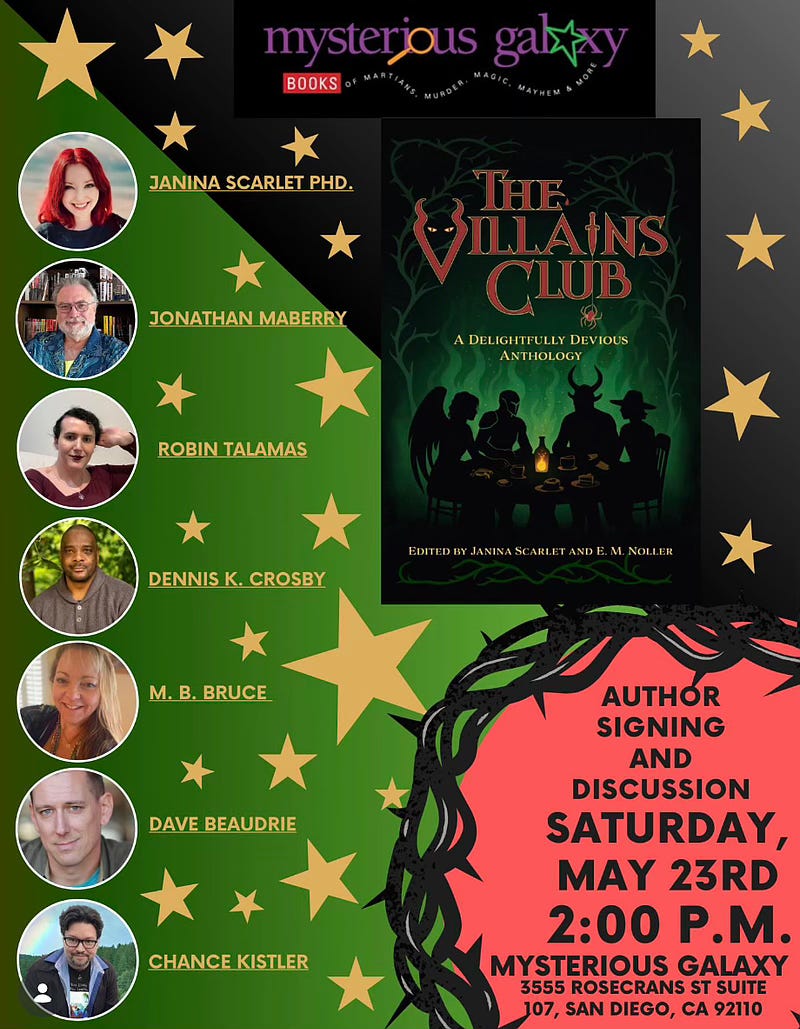
You can meet my co-editor, Dr. Janina Scarlet, and about half of the contributing authors of The Villain’s Club (including Jonathan Maberry, Chance Kistler, Dennis K. Crosby, Dave Beaudrie, M. B. Bruce, and Robin Talamas) at a panel discussion and book signing event at Mysterious Galaxy Books in San Diego May 23, 2025 at 2pm.
Remember you can always shoot me an email if you have questions about creative despair, and/or creating while neurodivergent.
Take care and keep writing,
Erin